
Found Mouse Droppings in Your House? Here's What to Know
You open a kitchen cabinet and notice several small, dark pellets in the corner. Or perhaps you've found something similar beneath the sink, behind an appliance, or among boxes in the garage. Could these be mouse droppings?
Finding mouse droppings in your house is a sign that rodents have been there, even if you've never seen one. But how can you tell whether they're from mice or rats, and does finding a few mean there's an active infestation?
Here's what homeowners in Phoenix, Tucson, and Southern Arizona should know about identifying mouse droppings, where they're commonly found, and when to contact Northwest Exterminating.
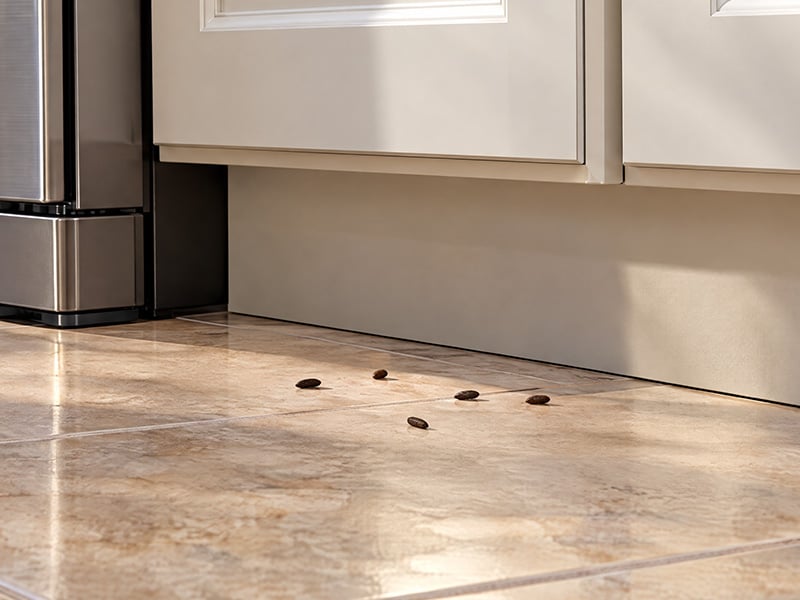
What Do Mouse Droppings Look Like?
Mouse droppings are small, dark pellets that resemble grains of rice. They generally measure between 1/8 and 1/4 inch long and have a narrow, elongated shape, often with pointed ends.
A few characteristics can help you recognize them:
-
Size: Usually between 1/8 and 1/4 inch long.
-
Shape: Elongated and somewhat pointed, rather than round.
-
Color: Typically dark brown to black, although color can vary with the mouse's diet.
-
Appearance: Fresh droppings may look dark and glossy, while older droppings often become dry and dull.
Both house mice and deer mice are found in Arizona, and their feces look very similar. You generally can't distinguish these species by droppings alone.
Although their appearance can provide clues about how recently rodents were present, it isn't a reliable way to determine whether the problem is ongoing. Avoid touching or disturbing droppings while trying to identify them.
Where Are Mouse Droppings Usually Found in a House?
Mice tend to leave droppings near food sources, nesting areas, and the routes they use to move through a home. Because they often travel along walls and behind objects, their droppings may accumulate in places homeowners rarely see.
Mouse Droppings in the Kitchen or Pantry
Kitchens are common places to discover mouse droppings because they provide access to food and water.
You might find them:
-
Inside lower kitchen cabinets and drawers
-
Along pantry shelves or behind stored food
-
On countertops, particularly near walls
-
Behind refrigerators, stoves, and other appliances
-
In corners or along baseboards
Finding droppings in a pantry may also mean mice have had access to packaged food. Small holes or gnaw marks in bags, boxes, and other packaging are additional signs to watch for.
Droppings near food preparation areas deserve prompt attention.
Mouse Droppings Under the Sink
The cabinet beneath a kitchen or bathroom sink is another place homeowners may discover mouse activity.
Plumbing openings can provide concealed routes between cabinets, wall voids, and other parts of the house. The cabinet itself offers a relatively undisturbed space where mice can travel without being seen.
If you've found them under the sink, check whether there are visible gaps around pipes or damage to stored items. These findings can help Northwest's technicians determine where activity may be occurring.
Droppings in Garages and Storage Areas
Arizona garages often hold holiday decorations, cardboard boxes, pet food, and other stored belongings. These areas can provide rodents with food, nesting materials, and places to hide.
Homeowners may discover droppings along garage walls, near stored boxes, or inside cabinets. Sheds and other outbuildings can also show signs of activity.
Mice aren't the only rodents that use these spaces. Pack rats are common throughout Southern Arizona and may establish nests in garages, sheds, and other protected areas around homes.
If you find larger droppings or piles of nesting debris, an inspection can help determine whether mice or rats are responsible.
Mouse Droppings vs. Rat Droppings in Arizona
Mouse and rat droppings can look similar at first glance, but their size and shape often provide useful clues.
For Arizona homeowners, the comparison should include house mice and deer mice as well as roof rats and pack rats.
House Mouse and Deer Mouse Droppings
House mice and deer mice leave very similar droppings, making them difficult to distinguish by appearance alone. Both generally produce smaller droppings than roof rats and pack rats, although sizes can overlap.
Roof Rat Droppings
Roof rat droppings are generally larger, measuring approximately 1/4 to 1/2 inch long. They tend to have tapered ends and may appear slightly curved.
Roof rats are established in parts of the Phoenix and Tucson areas. They're excellent climbers and may move through attics, rooflines, walls, and other elevated areas of a home.
Pack Rat Droppings
Pack rats, also called woodrats, produce droppings that are typically about 1/2 to 3/4 inch long, with more blunt or rounded ends.
These rodents are well adapted to Southern Arizona's desert environment. They often establish nests outdoors but can also occupy garages, attics, sheds, and other protected spaces.
Keep in mind: Dropping size alone doesn't confirm a species. Sizes can overlap, and younger rats may leave smaller droppings. Where the droppings are found, along with other signs of activity, can help with identification.
Does Finding Mouse Droppings Mean You Have an Infestation?
Finding mouse droppings tells you that a mouse or another rodent has been in that area. It doesn't necessarily tell you how many rodents are present or whether they're still inside.
A few pellets in one location could be evidence of a single mouse passing through. However, mice can produce numerous droppings each day, so the number you find doesn't necessarily correspond to the number of mice in your home.
There are other signs worth paying attention to, including:
-
Droppings in multiple rooms or locations
-
Gnaw marks on food packaging or stored belongings
-
Shredded paper, insulation, or other nesting materials
-
Scratching or scurrying noises after dark
You may never actually see a mouse, even when one is regularly moving through your house.
Found mouse droppings but haven't seen a mouse? Northwest Exterminating can help identify rodent activity and determine what needs to be done. Learn more about our rodent control services in Phoenix, Tucson, and Southern Arizona.
What Should You Do If You Find Mouse Droppings?
The first priority is to avoid disturbing the droppings unnecessarily.
Rodent waste can contain harmful microorganisms, and sweeping or vacuuming dry droppings may release contaminated particles into the air.
The Centers for Disease Control and Prevention recommends wearing gloves and thoroughly wetting rodent droppings with an appropriate disinfectant before wiping them up. Follow the product's directions, including its required contact time.
If you find droppings in your house:
-
Avoid sweeping or vacuuming them. Don't disturb dry droppings or nesting materials.
-
Address contaminated food. Discard food that rodents may have accessed or packaging that has been chewed or contaminated.
-
Follow CDC cleanup guidance. Use the recommended precautions for affected surfaces, and seek appropriate cleanup assistance for extensive contamination.
-
Have the rodent activity evaluated. Removing visible droppings doesn't address mice or rats that may still be using the area.
For enclosed rooms, garages, and outbuildings, the CDC also recommends opening doors and windows to ventilate the area for at least 30 minutes before cleaning, while remaining outside during that time.
In Arizona, deer mice are the primary carriers of Sin Nombre virus, which causes hantavirus pulmonary syndrome. That doesn't mean every mouse or pile of droppings carries the virus, but it is an important reason to take appropriate precautions.
For more information about this concern, read our article on hantavirus and deer mice in Arizona.
Stop Mouse Activity Before More Droppings Appear
Cleaning up mouse droppings doesn't eliminate the rodents responsible. If mice are still inside your home or finding ways to enter, more droppings and other signs of activity may follow.
Northwest Exterminating helps homeowners address the source of the problem through rodent control services that include inspections, trapping, and other targeted solutions. If mice or rats are entering through gaps around your home, our rodent exclusion service can help close off those access points.
For ongoing protection, Northwest also offers home pest control plans featuring 24/7 digital rodent monitoring to help detect activity before a larger problem develops.
Whether the evidence is in your kitchen, pantry, or garage, our team can help determine what's happening and recommend the right solution for your home.
Found mouse droppings in your home? Don't wait until you see a rodent. Contact Northwest Exterminating today to get help addressing mouse or rat activity in your home in Phoenix, Tucson, or Southern Arizona.

Testimonials
Request Your FREE Estimate
Have questions or need help getting rid of pests? Simply complete the form below or give us a call!
Pest Solutions For Homes & Businesses
Northwest Exterminating provides pest control services in the Phoenix metro and Tucson, as well as throughout Southern Arizona, that target pests found in our region's unique desert environment. We promise personalized service and state-of-the-art techniques for all your exterminating needs.
Any Pest, On Time, Guaranteed.








Northwest Exterminating Blog & News
Weed Control Requests Rise Across Tucson and the Phoenix Metro
Rodent Exclusion: How to Keep Rats and Mice Out of Phoenix and Tucson Homes