Posts from the ‘Spider ’ Category
Q: What is the myth with daddy-longleg spiders? and what do they look like?

Well believe it or not did you know that there are two creatures referred to as daddy-longlegs? and the real one isn’t the spider.
Both are part of the class arachnida, but they have their very own order - Opilion. Known as harvestmen, they are often confused as cellar spiders, pholcidae, crane flies or insects. In simplest observations, arachnids have eight legs, no wings and no antennae with two visible body segments usually six to eight eyes while crane flies, being insects have six legs and appear as one body segment with two eyes.
At any rate, it’s become acceptable to refer to pholcidae as daddy-longleg spiders as opposed to just daddy-longlegs, the title for the real deal.
Fossil evidence has reported that this species has existed for more than 200 years and nearly 6,500 have been discovered to date.
Harvestmen neither have spinnerets nor produce silk. If they’re in a web - they’re most likely the dinner. They eat all sorts of insects, earthworms, decaying plant matter and are very fond of aphids. Following dinner, they floss by pulling their legs one by one through their jaws. As they grow larger, they molt. After their outgrown body skin, or casing, splits, they then draw each long leg out of its worn casing.
Myths seem to persist, but daddy-longlegs are harmless to people because they don’t have poison glands. But if threatened, they may give off a stinky smell through scent glands.
When handled or caught, they can shed a leg which twitches, much like the familiar, green lizards known as anoles. This puts a daddy-longlegs at a disadvantage since legs are also used as sensory receptors. In addition, there doesn’t appear to be any recorded incidents of cellar spiders being venomous to or biting people.
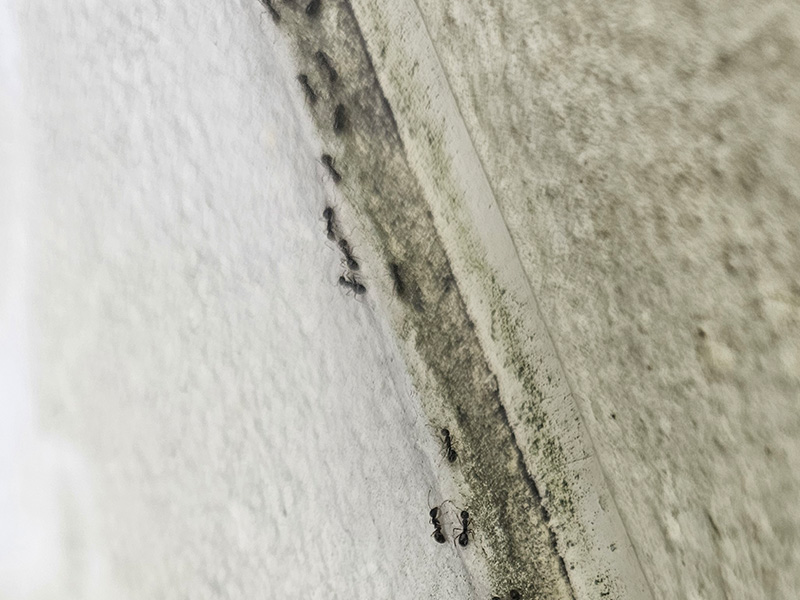
With a heat wave coming through Southern Arizona it is no wonder why so many pests are being seen. Plenty of homeowners and property owners have been coping with these creepy insects on a daily basis.
Angie’s List , which allows members to offer consumer reviews, records searches for pest control companies up 48 percent in March compared with the same month a year ago.
Phones are ringing off the hook – a full two months before the bugs usually arrive. These early unwanted guests include ants, bees and wasps, spiders and bed bugs.
Homeowners and property owners are better off calling professionals. People think they can save a lot going with do-it-yourself. They might be successful at first breaking up the colony but ultimately it can create more problems or simply the colony can repopulate elsewhere. Professional services, like Northwest Exterminating work like bug detectives. We are trained to look for the right and best solution for your property.
April’s temperatures have been at record-highs reaching up into the upper 90s. The thing with pests this month, is that it probably won’t stop. It will still continue on for several months. The pest invasion has begun….so beware!
Q: It is getting very warm this year in most areas of the United States. I was wondering if because of this specific weather change what type of critters and insects would be coming out?
It is true, that one of the USA’s warmest winters in years could possibly lead to a bug bonanza. over the next weeks with all kinds of insects like beetles, ants, termites and wasps all coming out much earlier than usual.
In some places, the onslaught has already begun. Many insects that are being seen are not the usual ones that come out this time of year; those that include stink bugs and boxelder bugs.
This widespread warmth is hitting several cities including New York, Chicago, Washington, etc. Winter is usually the time of months that insects hibernate but they may be emerging quite early from their hiding places. One key for the insects is that if they come out early, the flowers and plants they feed on must also bloom equally early. They have to be synchronized with what they’re feeding upon.
So contact northwest exterminatingfor all our pest control needs.
Q: I was just wondering do giant spiders really exist? You see them all the time in movies and tv shows like Harry Potter but would it really be possible for these giant insects to exist?
Let’s get one thing straight, everything that you see in movies and television shows is just to get the audience going and receive a emotional response or reaction. Most things that you see are make believe. Here is the proof:
1. Spiders do not have lungs. Air is delivered to parts of their body by way of branching tubes or (trachioles). The oxygen diffuses into the cells from tubes. In order for this diffusion to work efficiently it needs to be on a small scale. So giant spiders is really out of the question because they would not be able to breathe.
2. Spiders have skinny legs. That is not a huge problem for small insects but on a large body it would need something much stronger to support it.

Jumping spiders, have a keen vision and accurate pounce which makes them the “cats of the invertebrate world.” Researchers have been studying these critters for decades and have been puzzled by the way their miniature nervous systems can manage such sophisticated perception and hunting behaviors, until now.
A new study of the Adanson jumping spider fills in the key ingredient; that of depth perception. This spider, like all others has eight eyes. Two big ones that have the sharpest vision. This includes a lens that projects an image onto the light sensitive tissue at the back of the eye known as the retina. The retina consists of four distinct layers of light sensitive cells.